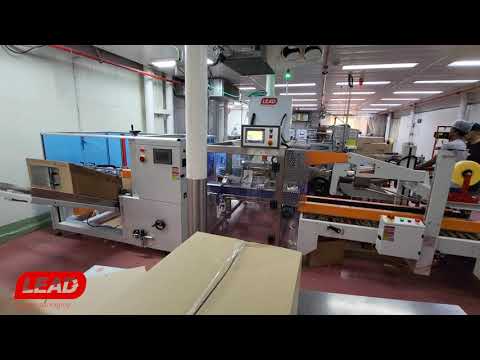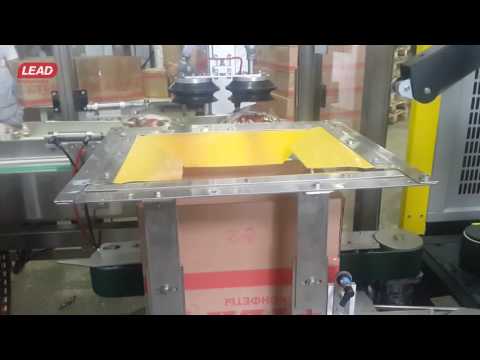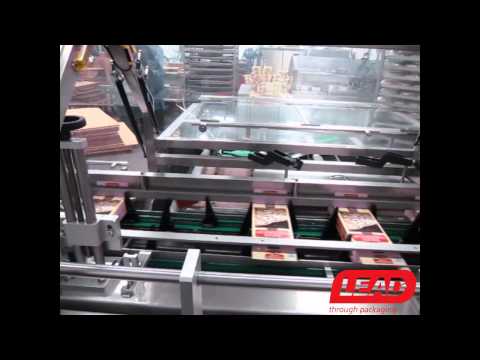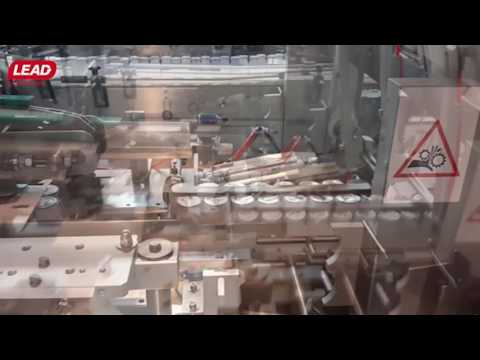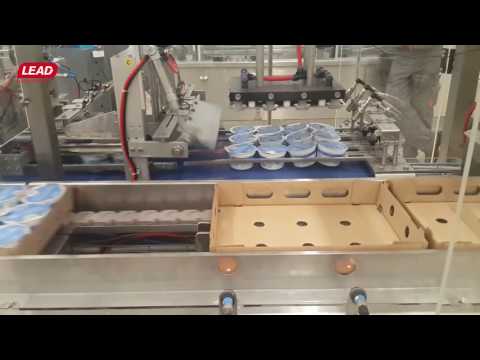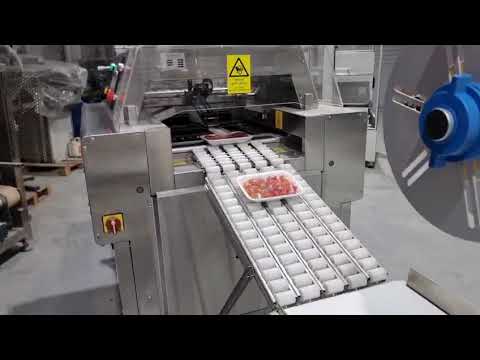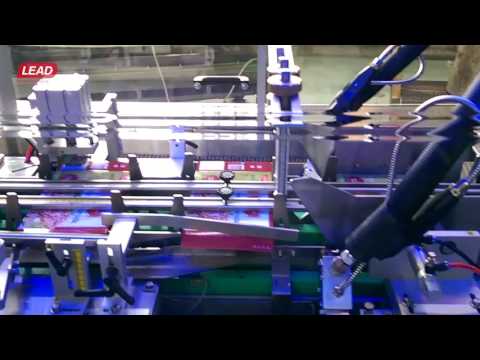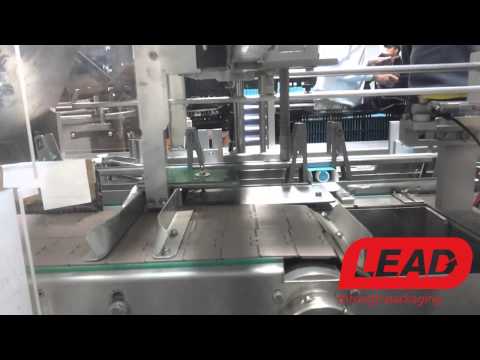
Several products often sell better as one retail unit. Holding them together with a paperboard sleeve can reduce the amount of plastic in the pack and simplify the secondary packaging step. This article covers cardboard sleeves, which are paperboard bands placed around a group of products. The word “sleeve” also describes shrink sleeve labels, which are plastic films applied to individual containers. Shrink sleeve labels are outside the scope of this article.
Our cardboard sleeve packaging machines form and close these multipacks. The sections below explain how the process works, how machine motion affects the choice, where sleeves suit dairy, ice cream and frozen products, and which board factors need testing.
Cardboard Sleeve or Shrink Sleeve Label: Which Format Fits
The two formats solve different problems. A cardboard sleeve groups products and provides a printable surface for the whole group.
A shrink sleeve label decorates or identifies a single container.
| Factor | Cardboard sleeve | Shrink sleeve label |
| Material | Paperboard | Plastic film |
| Level of application | A group of products | An individual container |
| Printed surface | A broad panel for branding and product details | A label around the container |
| Application | Formed around the group and closed | Film applied to the container and shrunk with heat |
| Typical use | Retail multipacks and secondary grouping | Container decoration and identification |
A sleeve leaves parts of the products visible. It does not form a sealed barrier, and its holding strength depends on the board, the dimensions and the closure. If a product needs a sealed outer layer or strong impact protection, a sleeve alone may not be enough. In that case, a full carton or a different film format should be reviewed.
How a Cardboard Sleeving Machine Works
The process has four stages: grouping the products, feeding the sleeve, forming it around the group and closing it. Machines differ in how they perform each stage.
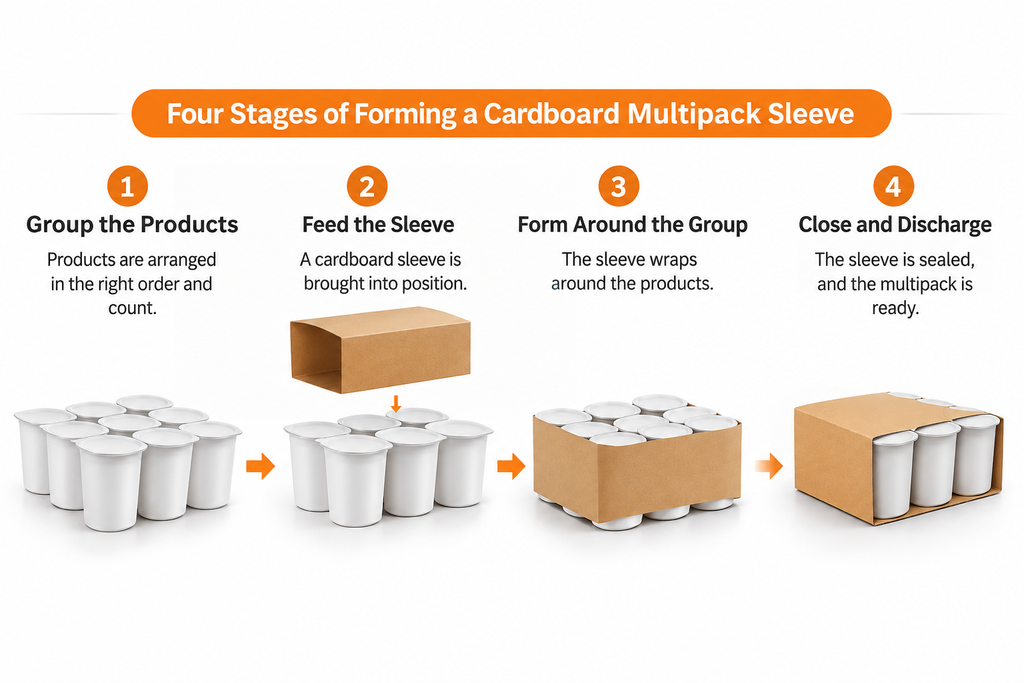
Grouping the Products
Products reach the sleeving station in a set arrangement of rows and units. Spacing and orientation should stay consistent before the sleeve is applied, because gaps or misaligned units change the fit. Our MP-10 uses a dual-belt or star-drive infeed.The infeed arranges products into the required number of rows and units per pack according to the required rows and unit count, and its eight motors are servo-driven, so each motion can be controlled separately.
Feeding and Forming the Sleeve
Some systems form the sleeve from a flat blank. Others apply a prepared sleeve. The choice depends on the machine and the sleeve format. The sleeve should match the overall size of the group, with a small allowance for product height and width. A sleeve that fits too tightly can deform the products, and a sleeve that fits too loosely can shift during handling.
Closing and Discharging the Multipack
Closure is usually made with hot-melt adhesive, a glue applied in liquid form that sets on cooling, or with locking tabs built into the sleeve design. The MP-70 and MP-10 use a hot-melt glue system. Glue performance depends on temperature and board, so it should be tested with your product. Closure details for the MP-50 are confirmed on request. After closing, the multipack moves to case packing or distribution, and overlap and alignment should stay consistent so the sleeve closes square.
Intermittent and Continuous Sleeving
Sleeving machines run on one of two motion patterns. The pattern affects how products enter the sleeve and how the line stays synchronized.
Intermittent Motion with the MP-70
In intermittent motion, products and sleeves pause at defined stations, and each operation has its own time window. The MP-70 works this way. Its feeder options include pick-and-place, side-pusher and rotary side-pusher arrangements, so the loading method can follow the shape and stability of the product. Configurations include two-, three- and four-side packs, one or two rows and one or two layers.
Continuous Motion with the MP-50 and MP-10
In continuous motion, products and sleeves move through the stations while every operation stays in step. This pattern suits lines with a steady supply.
The MP-50 is a continuous sleeve bundling machine. Its applications include yogurt cups, ready-meal trays, glass containers, beverage bottles, cans and preserved goods. Its product page also highlights quick adaptation to production-line changes.
The MP-10 is also a continuous bundler. Its servo-driven system controls each of its eight motors, and its infeed arranges products to match the required rows and units. Our MP-50 machine applications include yogurt cups, cans, preserved goods, ready-meal trays, beverage bottles and glass containers.
| Factor | Intermittent motion (MP-70) | Continuous motion (MP-50, MP-10) |
| Product movement | Pauses at each station | Moves through synchronized stations |
| Feeding | Selectable feeder arrangement | Infeed matched to rows and units (MP-10); adaptation to product shapes (MP-50) |
| Supply requirement | Operations timed to each cycle | Steady, consistent supply |
| Typical use | Configurable pack arrangements | Grouped multipacks on continuous lines |
Neither motion pattern is better in every case. Choose according to the product format, the pack arrangement and the supply rhythm of your line. Compare throughput using the same product format, because product dimensions change the result.
Applications: Dairy Cups, Ice Cream and Frozen Products
Sleeves suit several chilled and frozen products, but each product group has different requirements.
Dairy Multipacks
A paperboard sleeve can group several cups into one retail unit. It holds the group together and carries branding and product information. The MP-50 and MP-10 both can handle yogurt cups among their applications. Condensation from chilled cups can wet the board, so the board and closure should be tested under the actual cold-chain conditions.
Ice Cream Multipacks
Ice cream is often sold as individual items, where the primary packs provide most of the protection. In these cases, the sleeve’s main task is to group the units and present them. A carton encloses the product more fully, which can matter more for delicate or easily displaced items. The sleeve fit should be checked against the actual product arrangement before production begins.
Frozen Food and Ready-Meal Trays
Frozen distribution adds further demands. Paperboard absorbs moisture, and condensation forms when products move between temperature zones. Moisture can weaken the board, change its appearance and affect the adhesive. Coated or treated boards can improve moisture resistance, but the performance should be tested under the actual freezer and distribution conditions. When selecting a frozen food sleeving machine, check how the board and adhesive perform in cold storage. Condensation during temperature changes can also affect the sleeve’s strength and appearance. The board and adhesive for a frozen application should be confirmed with our team and tested with your product.
When a Sleeve May Not Be Enough
A sleeve may not suit a product that needs a sealed outer package, strong impact protection or a multipack that carries significant load. It also needs review when the board will be exposed to moisture beyond its rated resistance.
Board Selection and Print Area
Board Grade and Stiffness
A thicker board does not automatically perform better. The right grade depends on the weight of the grouped products, the sleeve dimensions, the closure method and the expected handling. Stiffness helps the sleeve keep its shape and protects the closure during handling. A board that is too stiff can crack along fold lines, so the grade should be tested with the folding and closing steps. Our machine pages do not set a board specification, so board selection is best made with your packaging supplier using samples from your own line.
Print Area and Closure Overlap
Artwork should be checked against the final sleeve dimensions and die-line before printing. The overlap needed for the closure reduces the usable print area, so the design should keep the logo and product details clear of the glue or lock zone. A test sleeve on the actual machine shows how the artwork aligns after closing.
Choosing a Cardboard Sleeving Setup
Start with the product: its dimensions, weight, number of units per multipack and the arrangement of rows and layers. Next, define the sleeve: blank format, board grade and closure. Then define the line: output target, chilled or frozen conditions, floor space and upstream supply.
| Requirement | Information to share |
| Product | Dimensions, weight and fragility of each unit |
| Arrangement | Rows, layers and units per multipack |
| Sleeve | Dimensions, blank format and board grade |
| Closure | Preference for glue or locking tabs |
| Artwork and panel layout | |
| Conditions | Chilled, frozen or ambient storage and transport |
| Output | Target multipacks per shift |
| Line | Upstream supply, floor space and downstream equipment |
Based on these inputs, our team can compare the three options. The MP-70 may suit operations that need several pack configurations and selectable feeders. The MP-10 may suit a continuous line that requires a controlled infeed by row and unit count. The MP-50 may suit continuous grouping of the product types listed on its page, subject to a review of your product and sleeve dimensions.
Talk to Our Team About Your Sleeve Application
Send us your product samples or dimensions, the multipack arrangement you need, the sleeve artwork or blank dimensions, your storage conditions and your target output. Use the contact page to arrange a consultation. Our team will review the application and recommend the machine and sleeve setup that fits your line.
Frequently Asked Questions
Can cardboard sleeves replace shrink film for multipacks?
In many cases, yes. A sleeve can replace shrink film when its main job is to group and present products and the primary packs already provide the required protection. A sleeve does not form a sealed outer barrier, so products that depend on one should be reviewed with a different format. We recommend a sample trial before changing the packaging design.
Which sleeve formats can one machine run?
Impac’s MP-70 offers configurations for two-, three- and four-side packs, one or two rows and one or two layers, with several feeder options. The MP-10 feeds products according to the required rows and units. The MP-50 handles products of different shapes and sizes, and its format range depends on the sleeve dimensions. Send your product and sleeve dimensions, and our team will confirm compatibility for each machine.
Do cardboard sleeves hold up in frozen conditions?
A sleeve may suit some frozen multipacks, but standard paperboard should not be assumed to withstand freezer conditions. Board grade, moisture resistance, adhesive performance and exposure to condensation all affect the result. Test the complete sleeve, including closure, through your actual storage and distribution cycle. Our team can review your conditions and suggest what to test.
Are sleeves closed with glue or with a mechanical lock?
Both methods are used. Glue is applied in liquid form and sets on cooling. A mechanical lock uses tabs or slots built into the sleeve blank. Our MP-70 and MP-10 use a hot-melt glue system. The closure method for the MP-50 is confirmed on request. Because locking tabs are part of the blank design, the sleeve and the machine should be planned together.