An IBC tote holds a large volume of liquid in a single container, so a filling error can lead to spills, product loss or fills outside the specified range. The 1,000 L size is common, but IBCs come in several capacities and designs. Filling method, product behavior, container stability and the target weight all affect whether the transfer goes cleanly.
This guide covers how to prepare the tote, choose between top filling and bottom-up filling, control the fill quantity and avoid the mistakes that cause spills, foaming and off-target batches. Some operations also use drum filling machines for other container formats.
What Makes an IBC Different from Smaller Containers
A composite IBC has three main parts. A rigid inner container, usually made from HDPE (high-density polyethylene, a tough plastic), holds the product. An outer cage protects it. A pallet base allows a forklift or pallet conveyor to move it. Each part affects how the tote is filled.
The filled weight is the main planning factor. A full 1,000 L tote can weigh well over a metric ton, depending on the product. The pallet, the floor and any weighing platform must handle that load. The container also needs headspace (the empty space left at the top) so that product expansion and temperature change do not push the liquid through the vent or closures.
IBC Top Filling vs. Bottom Filling
Two filling directions are common. They differ in where the liquid enters and how much it falls.
Top Filling Through the Upper Opening
In top filling, the nozzle delivers liquid through the upper filling port. The liquid falls into the tote, so the drop height influences splashing and foam. A short drop, a controlled flow rate and a well-positioned nozzle reduce turbulence. Top filling suits many products, particularly those that do not foam strongly or react to air contact.
Bottom-Up Filling With a Dip Pipe
In bottom-up filling, a dip pipe (a tube that enters through the upper opening and ends close to the base) carries the liquid to the bottom of the tote. The liquid rises from below, which reduces the free fall through the headspace. This can limit splashing and air entrainment (air bubbles drawn into the liquid).
Bottom-up filling is not the same as filling through the outlet valve. The bottom valve is intended for discharge, and standard composite IBCs are designed for pressure-free filling and emptying. For flammable liquids, bottom-up filling affects static electricity. Bonding and grounding (electrical connections that equalize charge between equipment and containers) and limits on filling speed apply in those cases. Guidance from EuPIA (the European Printing Ink Association) covers dip-pipe positioning and filling velocity. Apply that guidance to your product and check it against your site rules.
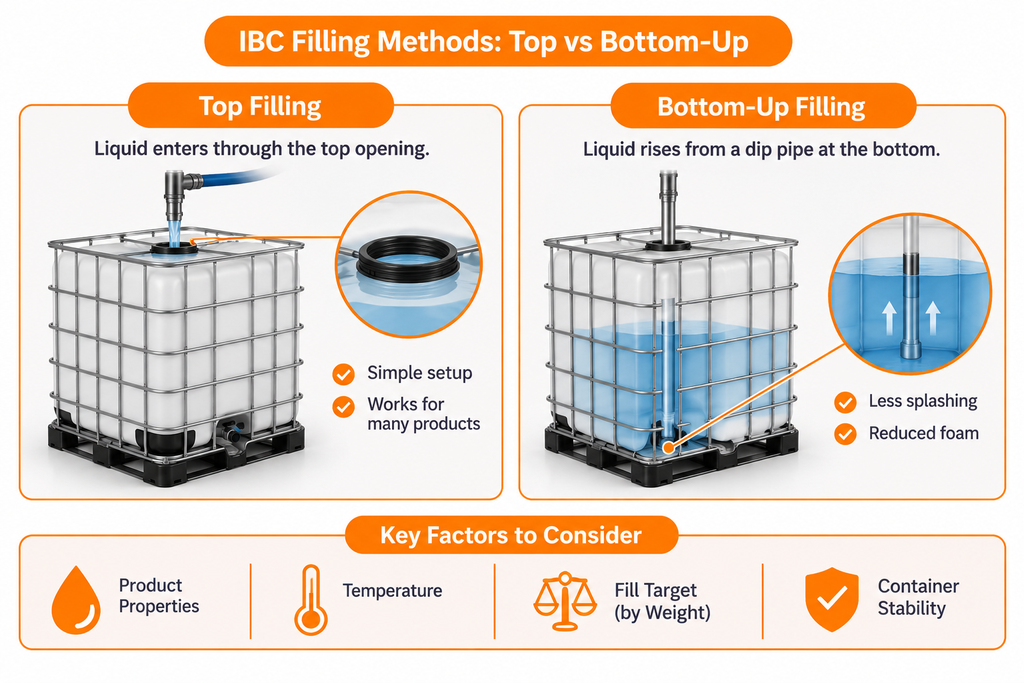
The table below summarizes the differences.
| Factor | Top filling | Bottom-up filling |
| Liquid entry | Through the upper opening | Through a dip pipe that reaches near the base |
| Splashing | Increases with drop height | Limited by the short distance from the pipe outlet |
| Foam and air entrainment | Depends on flow rate and product | Often reduced, depending on the product |
| Equipment needed | Standard nozzle and opening | Dip pipe of suitable length and positioning |
| Static considerations | Requires review for flammable liquids | Requires review for flammable liquids |
Positioning the Tote Before Filling
An important step in how to fill an IBC tote safely is positioning it on a level, stable surface before connecting the filling equipment. Align the upper opening with the nozzle or dip pipe. Confirm that the pallet is undamaged and can carry the filled weight. Check that the container will not shift during the cycle, because movement can affect both the flow and any weighing reading.
Move the tote with a forklift that has enough capacity for the filled weight. The forks should be long enough to support the full base of the pallet. Avoid dragging or pushing an IBC, since this can damage the base and the inner container. A pallet conveyor can replace forklift movement when totes follow a regular production sequence. The choice depends on floor space, production volume and how totes arrive and leave the line.
Semi-automatic equipment fits operations where an operator positions each tote and supervises the filling cycle. IMPAC FLEXEO-P is a semi-automatic IBC filling and capping machine. For the positioning method, weighing arrangement and suitability for your product, please ask our team.
Setting the Fill Target by Weight
Weight-based filling stops the flow when the scale reaches a set value. The scale reads the total weight of the tote, so the target must include the tote’s own weight.
The tare weight (the weight of the empty container, including the pallet) is subtracted from the gross reading to find the net weight of the product. For example, if a tote weighs 80 kg empty and the product has a density of 1.2 kg per litre, a 1,000 L fill contains 1,200 kg of product. The gross target is then 1,280 kg. Density changes with temperature, so the same 1,000 L can produce a different net weight from one batch to the next.
Load cells (sensors that convert weight into an electrical signal) need calibration. Vibration, uneven floors and movement of the tote can all shift the reading. Check calibration on a schedule that matches your quality system.
Controlling Foam During Filling
Foam forms when air mixes into a liquid and does not release quickly. Surfactant-containing cleaning products, syrups and some fertilizer solutions can foam readily. Foam takes up headspace and can make the level reading unreliable, so it affects both the fill quantity and the closure stage.
Start the flow at a low rate, then increase it once the nozzle or dip pipe outlet is submerged. Reduce the flow again near the target so the final addition does not disturb the surface. Allow the tote to settle before weighing or capping. Test the sequence with the actual product, since foam behavior depends on formulation and temperature more than on tote size.
Common Mistakes When Filling IBC Totes
The following mistakes cause most of the problems we see in IBC filling.
- Using a tote that is damaged, contaminated or unsuitable for the product. Check the inner container, seals and valve before each fill.
- Confusing litres with kilograms. The target should be set by the unit the specification uses, with density and tare weight included.
- Filling beyond the permitted level. Leave the headspace the container design specifies.
- Filling an unstable tote. A shifting tote can affect the scale reading and cause spills.
- Leaving the outlet valve or a closure open after filling. Confirm that every opening is sealed before the tote moves.
- Reusing a tote without checking its previous contents. Residues can react with the new product or contaminate it.
Choosing an IBC Filling Setup
The right setup depends on the product, the required quantity and the way totes reach the station. Product viscosity (thickness) and density affect the filling method and the flow rate. The fill quantity, measured by weight or volume, determines the measuring device. The tote size, opening and pallet type determine the nozzle and handling arrangement. Output per shift shapes whether manual positioning or a conveyor makes sense. Capping, cleaning and changeover needs can add further requirements.
IMPAC reviews these factors together. The FLEXEO-P is one option for semi-automatic IBC filling and capping. Please share your product data and tote specification with our team, so they can confirm the configuration suited to your application.
Talk to Our Team About Your IBC Filling Application
If you are planning a new IBC filling operation or reviewing an existing setup, share your product details, tote specification and target output with IMPAC. The contact page is the fastest route to our team. Our specialists will review the application and recommend a filling arrangement suited to your production requirements.
Frequently Asked Questions
How long does it take to fill a 1,000 L IBC?
There is no single answer, because the time depends on viscosity, flow rate, nozzle arrangement and the accuracy required. As a simple illustration, a flow of 50 litres per minute would move 1,000 litres in about 20 minutes. Positioning, weighing, cut-off and capping add time to the actual cycle. Our team can estimate cycle time for a specific product and setup.
Can one tote be used for different products?
Changing products in the same tote increases contamination and compatibility risk. The inner container, seals and valve may absorb or react with the previous product. A tote used for different products should be cleaned and inspected according to a documented procedure, and the new product should be checked against the materials. Dedicated totes for each product group are often the simpler route.
How should an IBC be inspected before reuse?
Check the inner container for cracks, scratches and deformation. Inspect the outlet valve, gaskets and closures for wear and proper sealing. Confirm the pallet and cage are undamaged. Review the tote’s history, since previous contents can affect the new product. Industry guidance such as EuPIA’s guidelines for IBC safe use provides more detail on inspection and reuse.
Is an IBC suitable for my product?
Suitability depends on the chemical composition, concentration, temperature and the tote’s construction. Start with the product’s safety data sheet and the tote supplier’s compatibility information. If the details are unclear, share the product data with our team, and we will identify which points need confirmation from the container supplier.