At 5 to 50 ml, a small difference in dose becomes a noticeable share of the target, and the pipette, closure and fill level all influence the final result. Teams that plan this work well usually settle the product properties, the bottle data and the closure design before they compare equipment.
This article describes the production steps, the factors that affect fill consistency and the information to gather before selecting a line. IMPAC’s pharma filling machines range covers several filling applications. The sections below focus on process decisions, so the equipment choice follows from the product and packaging data.
Dosing Accuracy at 5 to 50 ml
A fixed error has a larger effect on small fills. A 0.1 ml deviation equals 2% of a 5 ml fill and 0.2% of a 50 ml fill. The acceptable range should come from the product specification and the manufacturer’s own quality system. A filler alone does not define it.
Repeatability matters as much as the average. A line that delivers the right volume on average, but drifts from bottle to bottle, will produce more out-of-range units than a line with a slightly offset but stable average. Trend the results over a full run, not only the first ten bottles.
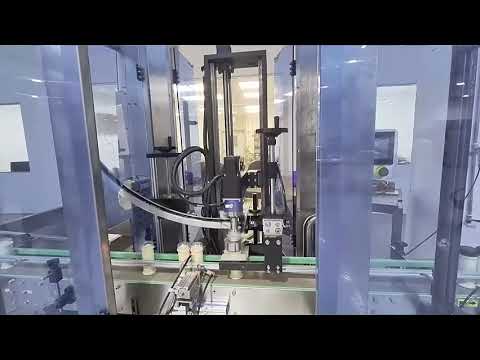
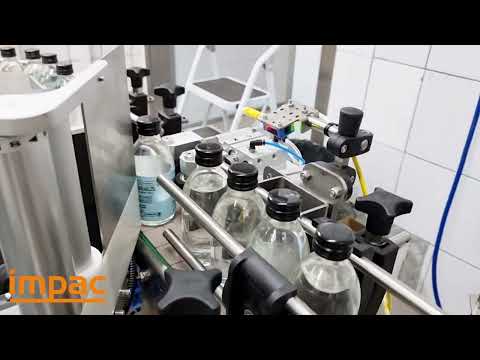
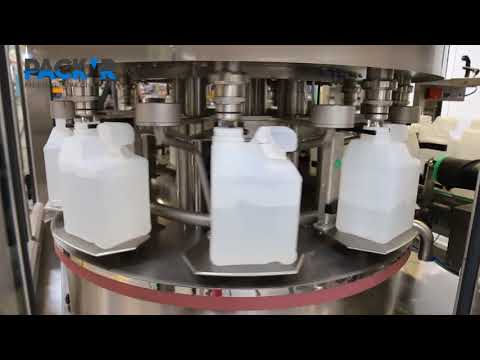
Filling, Pipette Insertion and Capping in One Process
Viscosity, Temperature and Nozzle Selection
Water-like liquids flow evenly through most nozzles. Oils, glycerin-based syrups and some suspensions resist flow, and they may leave a drop at the tip after cut-off. Temperature changes the viscosity of many formulations. A product filled in a cold room can behave differently from the same batch filled after a warm shift.
Nozzle diameter and tubing length change flow rate and the way liquid leaves the tip. The nozzle should be chosen with the formulation and the target volume in mind. Dosing technologies also differ in how they respond to viscosity changes, so trials with the actual product give the most reliable guidance.
Pipette Displacement and Fill Level
Inserting the pipette raises the liquid level in the bottle. If the bottle is overfilled, liquid can spill or enter the closure area. An underfilled bottle may contain less liquid than the net volume stated on the label.
Measure the level after insertion on sample bottles, then set the fill target from those results. The pipette length should reach the liquid at the lowest intended fill, so the final doses can be drawn without the tip sitting on the base.
Filling, Insertion and Closure Sequence
Most dropper lines fill the bottle first and insert the pipette afterward, although some designs reverse that order. The bottle shape and closure design decide the sequence. The steps below show the common order.
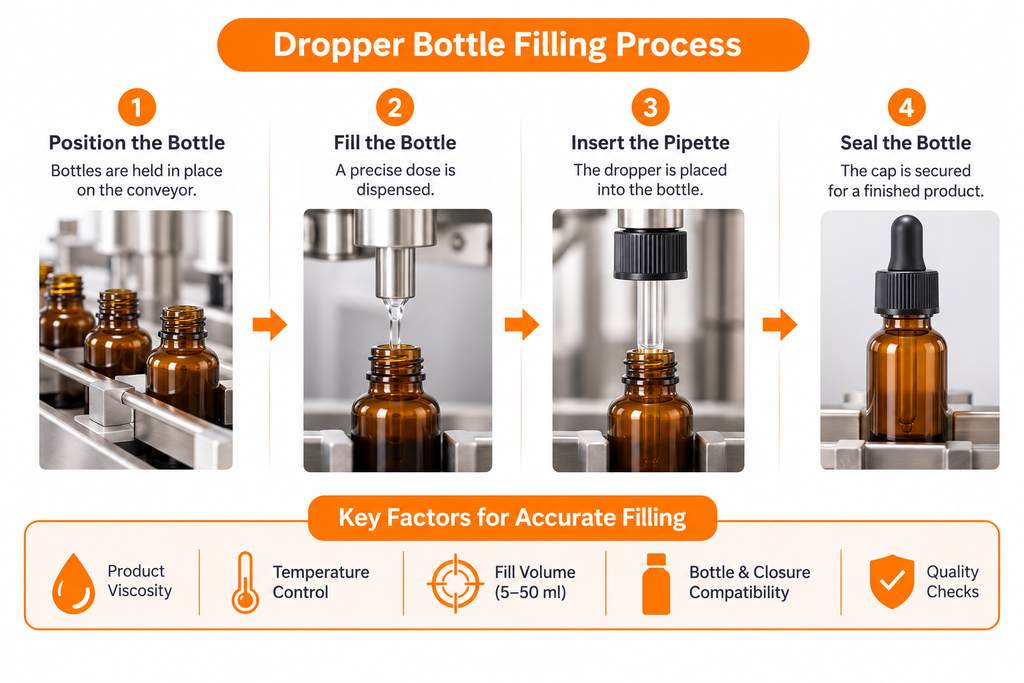
Bottles are positioned and held in place, then filled to the measured dose. The pipette assembly is fed, oriented and inserted to the set depth. The outer collar or cap is secured, and the finished bottle is checked for fill level, alignment and leakage.
Combining these stations in one line reduces transfers between operations, which can limit misalignment and spillage. Hygiene conditions still depend on the product, the room and the manufacturer’s procedures. Our liquid filling with pipette sealing solution uses the TORNADO filling and capping machine for this sequence. Details on bottle sizes, dosing method and changeover are confirmed for each project.
Bottle and Closure Compatibility
Glass and plastic bottles differ in wall thickness, weight and dimensional tolerance. These differences affect how the bottle centers in the fixture, how the neck finish meets the closure and how the collar seats. Test the complete assembly, including the bottle, pipette and closure, before confirming a configuration.
Changes between bottle heights and neck finishes usually require planned change parts. Record each size and closure combination so the changeover can be repeated on the same settings.
Product Groups and Their Filling Needs
Requirements vary by product, so the table lists the filling points for each group.
| Product group | Points to review during filling |
| Eye drops | Fill accuracy, dropper fit and the container-closure requirements set by the product’s sterility plan |
| Oral liquids | Viscosity, fill accuracy and agitation where the product is a suspension |
| Tinctures | Alcohol content, evaporation at the closure and compatibility of pipette and seal materials |
| Liquid supplements | Viscosity, density, suspended ingredients and residue at the neck |
| Oils | Viscosity, dripping and residue on the bottle neck |
Sterility, regulatory status and documentation come from the manufacturer’s quality system and product approvals. These requirements should be defined before equipment is selected, since they shape the line design, the cleaning routine and the verification steps.
Information That Shortens Equipment Selection
A recommendation depends on the product and packaging data. The most useful inputs are the formulation, viscosity and density at filling temperature, the target volume with its tolerance, the bottle material and neck finish, the pipette and closure drawings, the required output, the range of sizes to be run and any constraints from the existing layout. Sample bottles and closures allow the team to test fit before a quotation.
Contact Our Team
If you plan a new dropper bottle line or want to review an existing process, send us the product formulation, viscosity, fill target and tolerance, bottle and closure details, and the output you need. Use the contact page to arrange a consultation. Our team will review the application with you and tell you which points we can confirm and which need further information.
Frequently Asked Questions
Can glass and plastic dropper bottles run on the same machine?
It can be possible when the dimensional ranges of both bottles overlap and the closure fits both neck finishes. Change parts are often needed, and the full assembly should be tested on samples before confirming compatibility.
Do oils and tinctures need different filling settings?
Usually, yes. Oils are often more viscous and may drip, so the nozzle and cut-off settings need adjustment. Tinctures can contain alcohol, which affects closure and pipette materials and can change the product at the neck over time. Trials with the actual formulation give the most reliable settings.
How long does a changeover take?
The time depends on the size difference, the number of parts to change and whether the bottle and closure share a neck finish. Send sample bottles and closures, and our team will estimate the changeover for your sizes.
Can the filler be used for sterile eye-drop production?
Sterility depends on the whole process, including the facility, the materials, the cleaning routine and the controls set by the manufacturer. We can discuss the intended application and confirm which parts of the process our equipment covers. We will not present a machine as suitable for a sterile application before that confirmation.